Quick Verdict: There are several distinct Armenian bread types — paper-thin lavash for wrapping, hearty matnakash for the table, savory zhingyalov hats stuffed with herbs, and sweet gata and choreg for celebrations. Each has a specific role, and most Armenian households keep more than one on hand at all times.
Understanding the different Armenian bread types — and what each one is actually for — is the best way to appreciate why bread sits at the center of Armenian cuisine. Bread holds a place in Armenian culture that goes far beyond a side dish. It’s woven into weddings, blessings, and daily meals, with recipes and baking techniques passed down through generations largely unchanged for thousands of years.
Lavash: The Everyday Staple
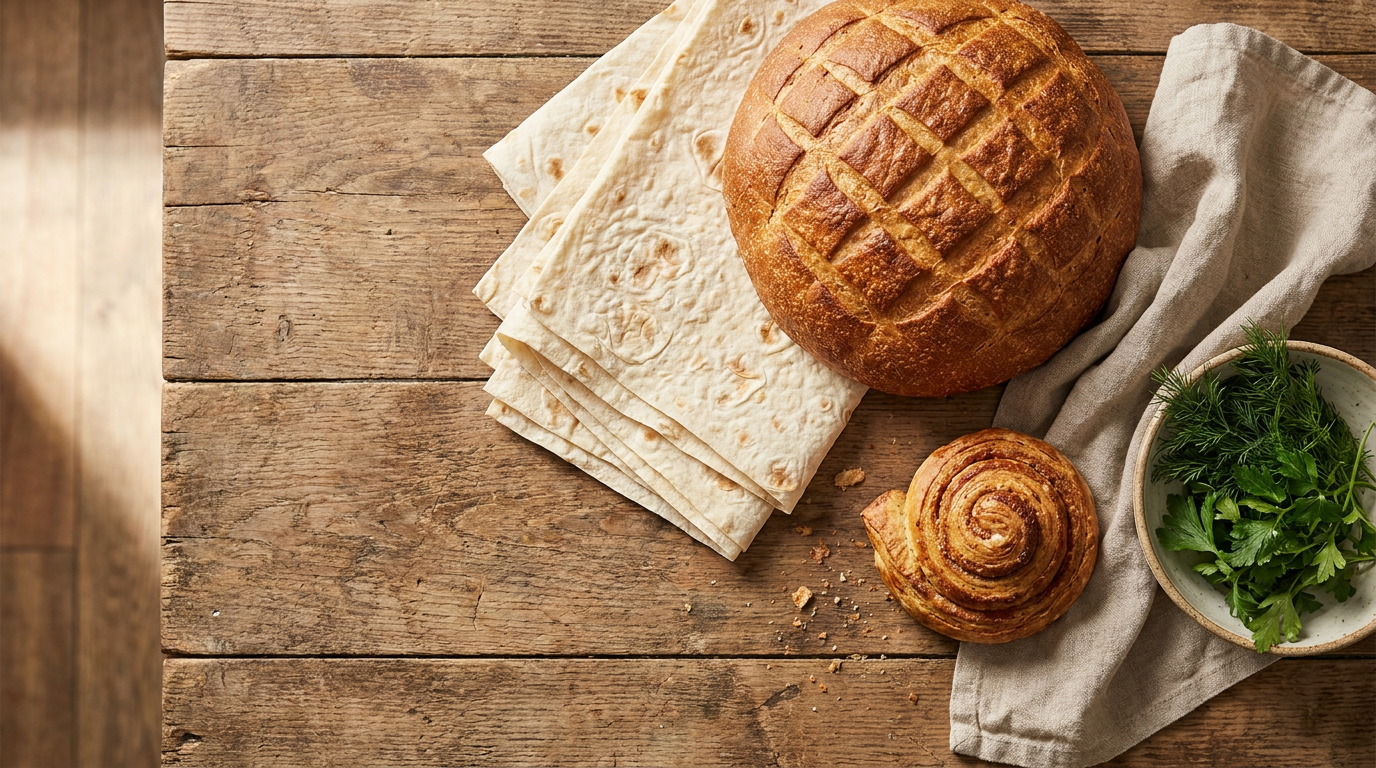
Lavash is the bread most people picture when they think of Armenian baking: a soft, thin, unleavened sheet made from just flour, water, and salt, traditionally baked against the hot walls of a clay tonir oven. It’s so central to Armenian identity that UNESCO recognized its preparation as an Intangible Cultural Heritage of Humanity in 2014.
Lavash is defined by its versatility. Fresh, it wraps around grilled meats and vegetables. Dried, it can be stored for months and rehydrated, or crumbled into soups like khash. It’s the bread Armenians reach for most often, for almost any purpose.
Want the full history and how to use it? Read our complete lavash guide.
Matnakash: The Hearth Bread
Among the major Armenian bread types, matnakash stands apart from lavash — where lavash is thin and pliable, matnakash is — a round, leavened loaf with a thick, chewy crust and soft interior, often scored with a distinctive crosshatch or grid pattern before baking. The name translates roughly to “kneaded with fingers,” referencing the traditional shaping technique.
Matnakash is closer to what most Westerners think of as “bread” in the everyday sense — sliceable, substantial, and meant to be torn and eaten alongside a meal rather than wrapped around one. It’s the loaf you’ll find at the center of an Armenian family table, served with cheese, herbs, and a spread of small dishes.
Zhingyalov Hats: The Herb-Stuffed Flatbread
A specialty of Armenia’s Artsakh region, zhingyalov hats is unleavened dough rolled thin and stuffed with a mixture of finely chopped greens and herbs — sometimes as many as 20 different varieties, depending on the season and region. It’s folded and cooked on a dry griddle until the dough is lightly charred and the greens inside have wilted into a fragrant, savory filling.
Historically a way to use up an abundance of spring greens, zhingyalov hats has become a beloved dish in its own right, often eaten as a light meal rather than a side.
Gata and Choreg: The Celebration Breads
Not all Armenian bread is savory. Gata is a sweet, layered pastry-bread with a buttery, slightly crumbly filling, often flavored with vanilla or cinnamon and shaped into a spiral or round loaf with a decorative pattern pressed into the top. Choreg is its close cousin — a soft, slightly sweet braided bread, traditionally flavored with mahleb (a spice from cherry pits) and often baked for Easter, sometimes with a dyed egg tucked into the braid.
Both are reserved for special occasions and holidays, standing apart from the everyday breads above as markers of celebration.
Ponak: The Stuffed Bread
Less widely known outside Armenia, ponak is a filled bread similar in spirit to a savory turnover — dough wrapped around a filling (often meat, cheese, or vegetables) and baked until golden. It varies significantly by region and household, making it more of a category of stuffed breads than a single fixed recipe.
What About Markouk and Sangak?
Unlike the Armenian bread types above, markouk and sangak come from different traditions entirely, you may have come across markouk and sangak — both delicious, both worth knowing, but both rooted in different traditions. Markouk (also called Lebanese mountain bread) comes from Levantine cuisine, prized for being even thinner than lavash. Sangak is a thick, stone-baked flatbread with Persian origins. Both pair beautifully with Armenian dishes and are popular across the broader Middle Eastern table, but they’re not traditionally Armenian breads themselves.
Curious about these too? Explore our markouk guide or our sangak guide.
Frequently Asked Questions
What is the most common Armenian bread?
Among all Armenian bread types, Lavash is the most widely eaten Armenian bread, used daily for wrapping, dipping, and serving alongside meals. It’s also the bread most associated with Armenian identity internationally.
What is the difference between lavash and matnakash?
Lavash is thin, unleavened, and flexible, ideal for wrapping. Matnakash is a thick, leavened, round loaf with a chewy crust, meant to be torn and eaten at the table rather than wrapped around food.
Is zhingyalov hats bread or a dish?
It’s both — a thin unleavened dough stuffed with a mixture of chopped herbs and greens, then griddle-cooked. It functions as a light meal on its own.
What bread is traditionally served at Armenian celebrations?
Gata and choreg are the two most common celebration breads. Gata is a sweet, layered pastry-bread eaten year-round for special occasions; choreg is a braided sweet bread traditionally baked for Easter.
Are markouk and sangak Armenian breads?
No — markouk originates from Levantine (Lebanese) cuisine, and sangak is Persian in origin. Both are popular across the wider Middle Eastern table and pair well with Armenian dishes, but they aren’t traditionally Armenian.
Now that you know the major Armenian bread types, here’s where to start. Shop our fresh-baked lavash flatbread, baked in our Commerce, California bakery and shipped nationwide
