
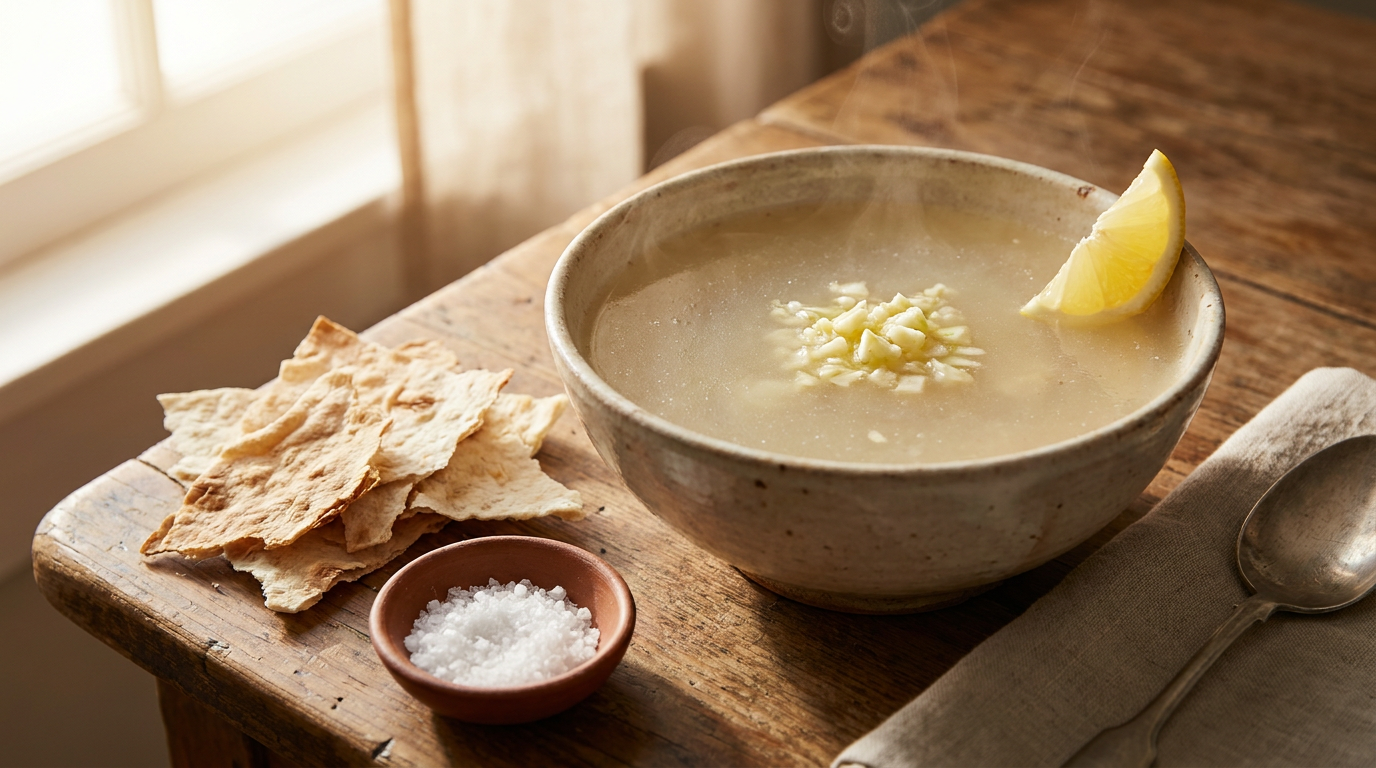
Simmered overnight, eaten for breakfast, and chased with vodka — khash is Armenia’s legendary hangover cure and one of its most social culinary traditions. Here’s what it is, how it’s made, and how to serve it the traditional way.
What Is Khash?
A recipe for the Armenian soup called khash, at its most basic, goes something like this: simmer cows’ hooves overnight, serve. Traditionally, khash is served with dried lavash, which is crumbled into the broth — our ARA-Z Lavash Flatbread is perfect for this, simply dry pieces in a warm oven overnight for an authentic experience.
Gelatinous beef trotters — flavored tableside with sinus-clearing add-ins like lemon, salt, vinegar and raw garlic — may sound like the last thing you’d reach for when nursing a hangover, but Armenians swear by khash’s panacean powers, particularly in the winter, when it’s customarily eaten. Across the small Caucasus nation, friends gather for morning-after khash feasts complete with ritualistic toasts and — as Anthony Bourdain discovered while shooting a Parts Unknown episode — punishing hair-of-the-dog vodka shots. Offal soups are quintessential hangover fare across many cultures, from Mexican menudo rojo to Albanian paçe to Korean haejangguk, but none, perhaps, is as much of an event as Armenian khash.
Khash isn’t unique to Armenia — versions of the same idea turn up across the Caucasus and Middle East. Georgia has khashi, a nearly identical hooves-and-garlic soup eaten the same way, at the same hour, for the same reason. Azerbaijani and Iranian kitchens have their own hoof-and-trotter broths, and dishes built on slow-simmered bones and connective tissue show up throughout the region’s winter cooking. What sets Armenian khash apart is less the ingredient list than the ritual around it — the toasts, the timing, and the insistence that it’s eaten with friends, not alone.
A Dish Rooted in Necessity
Khash didn’t start as a delicacy — it started as a way to waste nothing. In rural Armenia, cattle were traditionally slaughtered in late autumn and early winter, once the weather turned cold enough to preserve meat without refrigeration. The prime cuts were reserved for other dishes or preserved for the months ahead, but the hooves — considered close to worthless by butchers focused on meat yield — were nearly free. Boiled long and slow, they release enough natural gelatin to thicken into a rich, satisfying broth without a scrap of muscle meat involved.
That thrift is baked into khash’s cultural DNA. It became associated with winter specifically because that’s when the ingredients were on hand — right after slaughter season — and because a bowl of hot, fat-rich broth in the morning was exactly what someone needed before a day of physical winter work, or after a night of drinking. The dish’s reputation as a hangover cure grew out of the same practical logic: khash was simply what was available, and it happened to work.
The All-Day Khash Tradition
Khash-fueled breakfasts start around 9 a.m. and unfold into a full day of gathering, toasting, and celebration.
“Khash parties are all-day affairs. After you’ve eaten the soup in the morning and made the accompanying toasts — to the day, to the cooks, and to the guests, in that order — you drink and sing and dance like crazy. When people get hungry again, you might have a barbecue, followed by coffee and tea and sweets.”
Samvel Hovhannisyan, owner of Bureaucrat Café and Bookstore in Yerevan
How Khash Is Traditionally Prepared
Even the soup’s preparation is a production. The hooves must be plucked meticulously of any stray hairs and soaked in water for a day to remove impurities and funky odors. Then comes the cooking — an eight-hour simmer requiring hourly check-ins, lest the pot dry out. Cooks often literally lose sleep over the dish to have it ready by breakfast.
“It’s a sacrifice. That’s why the toast to the cook is so important.”
Samvel Hovhannisyan
Serving Khash: Lavash, Garlic & Vodka
For the broth to remain white and nearly transparent — the mark of a well-made khash — Armenian cooks don’t add salt to the pot during cooking; it’s up to the end user how much salt and other traditional flavorings to mix in. Armenians are known to add up to eight cloves’ worth of garlic to each portion.
Two types of lavash always grace the table: dry, for crumbling into the broth, and fresh, for draping over the bowl to seal in the heat. Purists insist that fresh lavash — torn and folded for easy scooping — is the only acceptable utensil for eating khash, and that vodka, never wine or beer, is its only worthy sidekick.
Who Eats Khash? Then and Now
Traditionally, khash feasts were restricted to men, who also presided over the preparation of the soup — a novelty in a region with a culinary tradition otherwise dominated by women. The pungent aromas of the soup, and its associated vodka troughs, were once deemed unacceptable to women; men and women traditionally ate separately in Armenia more broadly, so the division persisted.
Khash lovers in present-day Armenia are young and old, wealthy and poor — though it goes without saying, in a world where almost one-third of the population lives in poverty, that not everyone has the resources to throw lavish feasts.
In Yerevan today, dedicated khash houses open before dawn on weekend mornings and fill with multi-generational groups — grandfathers who grew up on the dish sitting across from grandchildren trying it for the first time. It has become something of a social ritual as much as a meal: a reason for extended family and old friends to sit down together on a cold Saturday, in a city where everyday schedules otherwise pull people apart.
Bringing Khash Home
Khash isn’t a dish most people improvise on a weeknight — it’s a project, and Armenian households usually treat it as one, often starting the hooves the night before a planned breakfast. If you’re recreating the tradition at home, the lavash matters as much as the broth. Dry your lavash a day ahead by leaving pieces uncovered at room temperature, or crisping them briefly in a low oven, so they’re ready to crumble into the bowl rather than turning to mush the moment they hit the broth. Keep a second batch of lavash fresh and pliable for tearing and scooping, and set out lemon, salt, and raw garlic on the side so each guest can season their own bowl at the table, the way it’s done in Armenia.
Traditional Khash Pairings
Khash is a cherished Armenian tradition, and the right lavash makes all the difference. Our flatbreads are baked fresh daily using traditional methods — the perfect accompaniment to this historic dish.
| Bread | Why It Works | Shop |
|---|---|---|
| ARA-Z Lavash Flatbread | The classic choice — dry it overnight, then crumble into the broth the traditional way. | Shop → |
| Stone Lavash | Heartier texture that holds up when crumbled into soup without disintegrating. | Shop → |
| ARA-Z Variety Pack | Try both dry and fresh styles side by side to find your preference. | Shop → |
Frequently Asked Questions
What is khash made of?
Khash is traditionally made from cows’ hooves, simmered overnight into a rich, gelatinous white broth. It’s served with raw garlic, lemon, salt, and vinegar added at the table, plus dry and fresh lavash for crumbling and scooping.
Why is khash traditionally eaten in winter, or as a hangover remedy?
Armenians consider khash a panacea, especially in cold months, and it’s a classic morning-after dish — khash breakfasts often start around 9 a.m. and are followed by “hair of the dog” vodka toasts.
Is khash still commonly eaten in Armenia today?
Yes — khash remains popular across generations and income levels in present-day Armenia, though large traditional feasts require more resources than an everyday meal.
What’s the difference between khash and other Armenian soups, like khorovats-adjacent dishes?
Khash is an offal-based winter/hangover soup built around simmered hooves, distinct from khorovats (grilled meat) — see our Khorovats & Kebabs guide for that tradition.
What bread is khash traditionally served with?
Two kinds: dry lavash, crumbled directly into the broth, and fresh lavash, torn and folded to scoop with. Stone Lavash is a heartier alternative for crumbling since it holds up well in soup.
Was khash traditionally eaten only by men?
Historically yes — khash feasts and their preparation were traditionally restricted to men, reflecting broader customs of separate dining between men and women in Armenia. That tradition has loosened over time.
Can I recreate khash outside Armenia?
Yes — cow’s hooves are available from many butchers and Middle Eastern or Eastern European grocers, even outside Armenia. The technique translates directly: a long, slow simmer, minimal seasoning during cooking, and garlic, salt, lemon, and vinegar added at the table. Pair it with dried ARA-Z Lavash Flatbread for an authentic finish.

Leave a Reply
You must be logged in to post a comment.