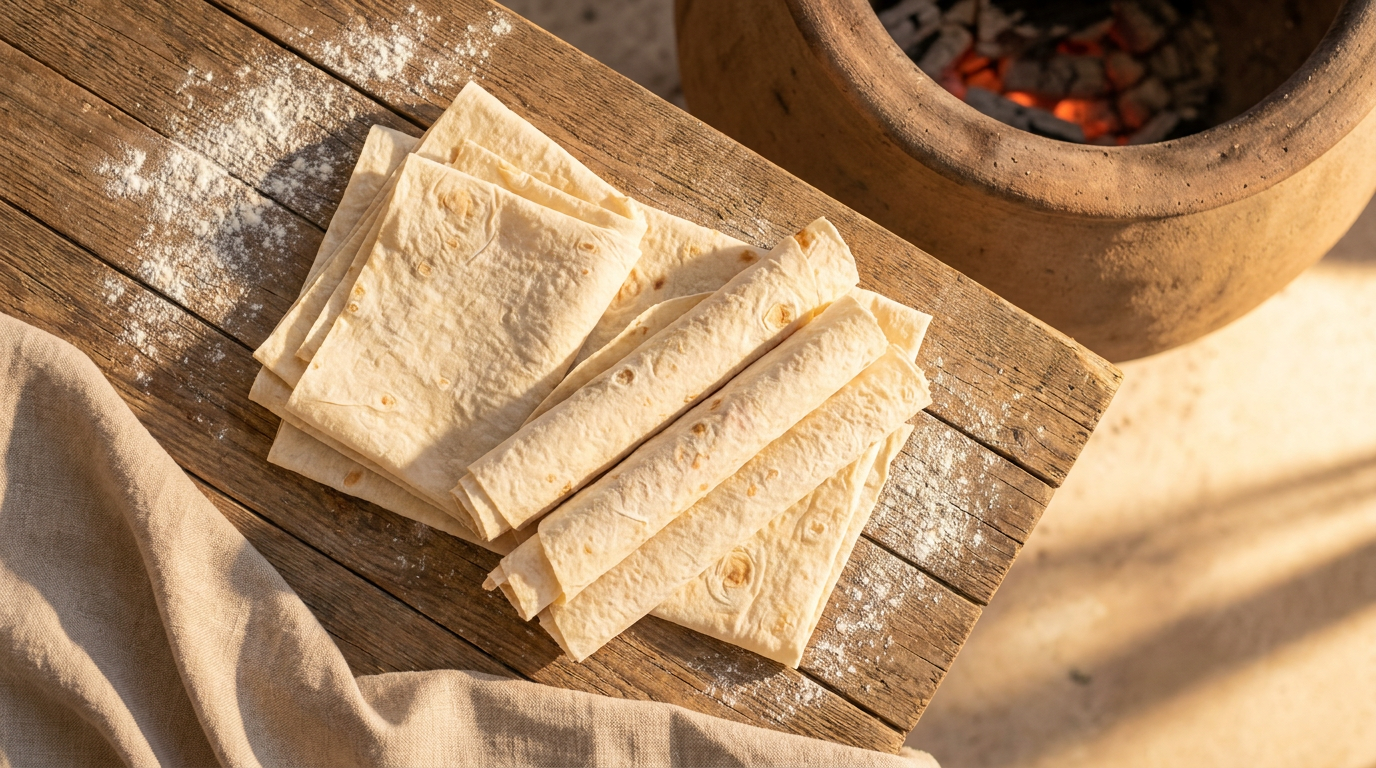
There are breads that feed people, and then there are breads that carry the soul of a civilization. Lavash is the latter. Soft, thin, and impossibly versatile, this ancient Armenian flatbread has been baked on the hot walls of clay ovens for thousands of years — long before modern kitchens, long before packaged bread, long before much of the world had developed a written language. Today it is recognized by UNESCO as an Intangible Cultural Heritage of Humanity. And yet, at its heart, it remains what it has always been: flour, water, salt, fire, and the hands of someone who knows how.
What Is Lavash Bread?
Lavash is a soft, thin unleavened flatbread of Armenian origin, beloved across the South Caucasus, Western Asia, and the areas surrounding the Caspian Sea. Made from just three ingredients — wheat flour, water, and salt — it is proof that simplicity, when mastered, needs nothing else.
The thickness of lavash varies depending on how thinly the dough is rolled out. Some sheets are almost translucent, delicate enough to wrap around a sprig of herbs or a sliver of cheese. Others are slightly thicker, more forgiving, perfect for tearing and dipping. Toasted sesame seeds or poppy seeds are sometimes scattered across the surface before baking, adding a gentle nuttiness and visual warmth.
According to the Encyclopedia International, “Common to all Armenians is their traditional unleavened bread, lav-ash, which is a staple in the Armenian diet.” The name itself carries meaning: folk etymology traces it to “lav-hats” — quite simply, “good bread” in Armenian. Linguists connect it further to the Armenian “lovaz” meaning palm or flat of the hand, and “lavaz” meaning very thin. A bread named for what it is: flat, thin, and good.
A Bread Baked Through the Ages
The story of lavash is the story of Armenia itself — ancient, resilient, and deeply tied to the land. Archaeologists working in Armenia have uncovered ancient fire pits strikingly similar to the tonir ovens that are still used to bake lavash today. The method has not changed in any meaningful way. Long sheets of dough are stretched by hand, draped over a special oval cushion, and slapped against the hot interior walls of a conical clay oven. Within thirty seconds to a minute, the bread is done — pulled from the wall while still steaming, blistered in places, impossibly thin.
That continuity — the same motion, the same oven, the same bread across millennia — is part of what makes lavash so extraordinary. Generations of Armenian women have passed the skill from mother to daughter, from grandmother to granddaughter, each learning the feel of properly stretched dough, the rhythm of the oven, the particular scent of lavash in the last seconds before it is ready.
Lavash is also distinctly Armenian in identity. As the linguist H. Adjarian noted in 1926:
“Lavaš is considered to be Armenian bread in both Yerevan and Iran (being opposed with sangak for Turks and Persians), and in Tehran this bread is called nūn-i armanī ‘Armenian bread’. Similar data can be found also for other regions. In Dersim, for instance, lavaš is seen as characteristic for Armenian hospitality whereas the Kurdish entertain with sači haċʿ”
UNESCO Recognition: A Heritage Worth Protecting
In 2014, the world formally acknowledged what Armenians had always known. Lavash was inscribed on UNESCO’s Representative List of the Intangible Cultural Heritage of Humanity — not just as a food, but as a living cultural practice. Armenia’s Foreign Ministry announced that the “preparation, meaning and appearance of traditional bread as an expression of culture in Armenia” had been included during the 9th Session of UNESCO’s intergovernmental committee in Paris.
UNESCO’s own description captures why it matters so deeply:
Lavash is a traditional thin bread that forms an integral part of Armenian cuisine. Its preparation is typically undertaken by a small group of women, and requires great effort, coordination, experience and special skills. A simple dough made of wheat flour and water is kneaded and formed into balls, which are then rolled into thin layers and stretched over a special oval cushion that is then slapped against the wall of a traditional conical clay oven. After thirty seconds to a minute, the baked bread is pulled from the oven wall. Lavash is commonly served rolled around local cheeses, greens or meats, and can be preserved for up to six months. It plays a ritual role in weddings, where it is placed on the shoulders of newlyweds to bring fertility and prosperity. The group work in baking lavash strengthens family, community and social ties. Young girls usually act as aides in the process, gradually becoming more involved as they gain experience. Men are also involved through the practices of making cushions and building ovens, and pass on their skills to students and apprentices as a necessary step in preserving the vitality and viability of lavash making.
Two years later, in 2016, making and sharing flatbread — lavash, katyrma, jupka, and yufka — in communities of Azerbaijan, Iran, Kazakhstan, Kyrgyzstan, and Turkey was also inscribed on the UNESCO list. But lavash remains, at its core, Armenian bread. The recognition did not create its importance. It simply confirmed what had been true for thousands of years.
Types of Lavash at Breadmasters
Not all lavash is the same. The tradition has evolved across regions and generations, giving rise to different styles, each with its own character and best use. At Breadmasters, the lavash family includes:
| Product | Character | Best For |
| ARA-Z Lavash Flatbread | The classic. Soft, pliable, thin — the most traditional expression of Armenian lavash | Wraps, rolling, traditional serving |
| Markook Thinnest Flatbread | Ultra-thin, almost translucent. The most delicate of the lavash family | Kebab wraps, delicate rolls, lavash chips |
| Stone Lavash Whole Wheat | Heartier texture, wholesome flavour from whole wheat flour | Sandwiches, dipping, tearing |
| ARA-Z Variety Pack | A selection of Breadmasters lavash styles in one box | First-time buyers, gifts, exploring the range |
Each is baked in California using time-honoured methods that have defined Armenian lavash for generations. No preservatives, no unnecessary additives — just the bread as it was always meant to be.
How to Use Lavash Bread
Lavash is one of the most versatile breads in the world. Its thin, flexible nature means it can go where thicker breads cannot, and its mild, slightly earthy flavour means it complements rather than competes with whatever it carries.
Wraps and Rolls
This is lavash at its most natural. Lay a sheet flat, layer grilled meats, roasted vegetables, fresh herbs, and a drizzle of sauce, then roll tightly. The bread holds its shape without cracking. Traditional Armenian khorovats — grilled meat — wrapped in fresh lavash is one of the great simple pleasures of the cuisine.
Served Alongside Meals
In Armenian households, lavash appears at almost every meal as a companion rather than a focus. Tear a piece and use it to scoop up hummus, moutabal, or a bowl of thick yoghurt. Lay it next to a cheese board. Use it to mop up the last of a rich stew. There is no more honest way to eat bread.
Lavash Pizza
The thinness that makes lavash perfect for wrapping makes it equally perfect as a pizza base. Top with sauce, cheese, and toppings, then bake at high heat until the edges crisp. The result is a flatbread pizza with a cracker-like crunch that thicker bases simply cannot achieve.
Lavash Chips
Cut or tear lavash into pieces, brush lightly with olive oil, sprinkle with sea salt or za’atar, and bake until golden and crisp. Lighter than crackers, more flavourful than crisps, and gone within minutes of leaving the oven.
Dried and Crumbled
Lavash that has dried out is not wasted — it is transformed. Crumble dried lavash into Armenian khash (a traditional bone broth soup) or any hearty broth for depth and texture. This is one of the oldest uses of the bread, stretching back through centuries of Armenian winters.
How to Store Lavash Bread
One of lavash’s most remarkable qualities is its longevity. As UNESCO notes, it can be preserved for up to six months when dried properly — a feature that made it invaluable across the Caucasus through long winters. For modern households, storage is straightforward:
| Method | Duration | How | Best For |
| Room temperature | 3–5 days | Sealed bag or wrapped in cloth | Daily use |
| Refrigerator | 2–3 weeks | Sealed airtight bag | Regular use |
| Freezer | Up to 6 months | Stack flat, wrap tightly | Bulk buying |
| Dried intentionally | Several months | Leave unwrapped in dry air | Soups, chips |
To refresh dried lavash, sprinkle both sides lightly with water, wrap in a damp cloth, and leave for five minutes. To thaw frozen lavash, leave at room temperature for 20–30 minutes or warm briefly in a low oven.
Bring Home the Taste of Armenian Heritage
| Lavash isn’t just bread — it’s a symbol of Armenian culture, recognized by UNESCO and cherished for millennia. Experience the authentic taste baked for thousands of years, made fresh and shipped to your door. |
Our Lavash Collection
| ARA-Z Lavash Flatbread | The classic, all-purpose traditional lavash | Shop Now → |
| Markook Thinnest Flatbread | Ultra-thin for delicate wraps and rolls | Shop Now → |
| Stone Lavash | Hearty texture perfect for sandwiches and dipping | Shop Now → |
| Variety Pack | Try all three and find your favorite | Shop Now → |
Frequently Asked Questions
What is lavash bread made of?
Lavash is made from just three ingredients: wheat flour, water, and salt. There are no leavening agents, no preservatives, and no additives in traditional lavash. Its simplicity is part of what has kept the recipe unchanged for thousands of years.
Is lavash bread healthy?
Lavash is one of the leaner flatbreads available. Because it contains no yeast, oil, or added fats, it is lower in calories than most other breads of comparable size. Whole wheat varieties like Stone Lavash provide additional fibre and nutrients. It is also naturally vegan and dairy-free.
What is the difference between lavash and pita?
Pita is a leavened flatbread that puffs up during baking, creating a pocket inside. Lavash is unleavened and remains flat and thin. Lavash is better for wrapping and rolling, while pita is ideal for stuffing. Both are delicious — they simply serve different purposes.
How long does lavash bread last?
Fresh lavash keeps at room temperature for 3–5 days in a sealed bag, refrigerated for 2–3 weeks, or frozen for up to 6 months. Read our full guide on how to store lavash bread for step-by-step methods and how to revive it before serving.
Where can I buy authentic lavash bread online?
Breadmasters ships authentic Armenian lavash fresh from our California bakery across the United States. Our ARA-Z Lavash, Markook Thinnest Flatbread, Stone Lavash, and Variety Pack are available at breadmasters.com/shop. All breads are made using traditional recipes with no preservatives.
Read more at: https://www.peopleofar.com/2014/06/03/armenian-flatbread-lavash/

Leave a Reply
You must be logged in to post a comment.