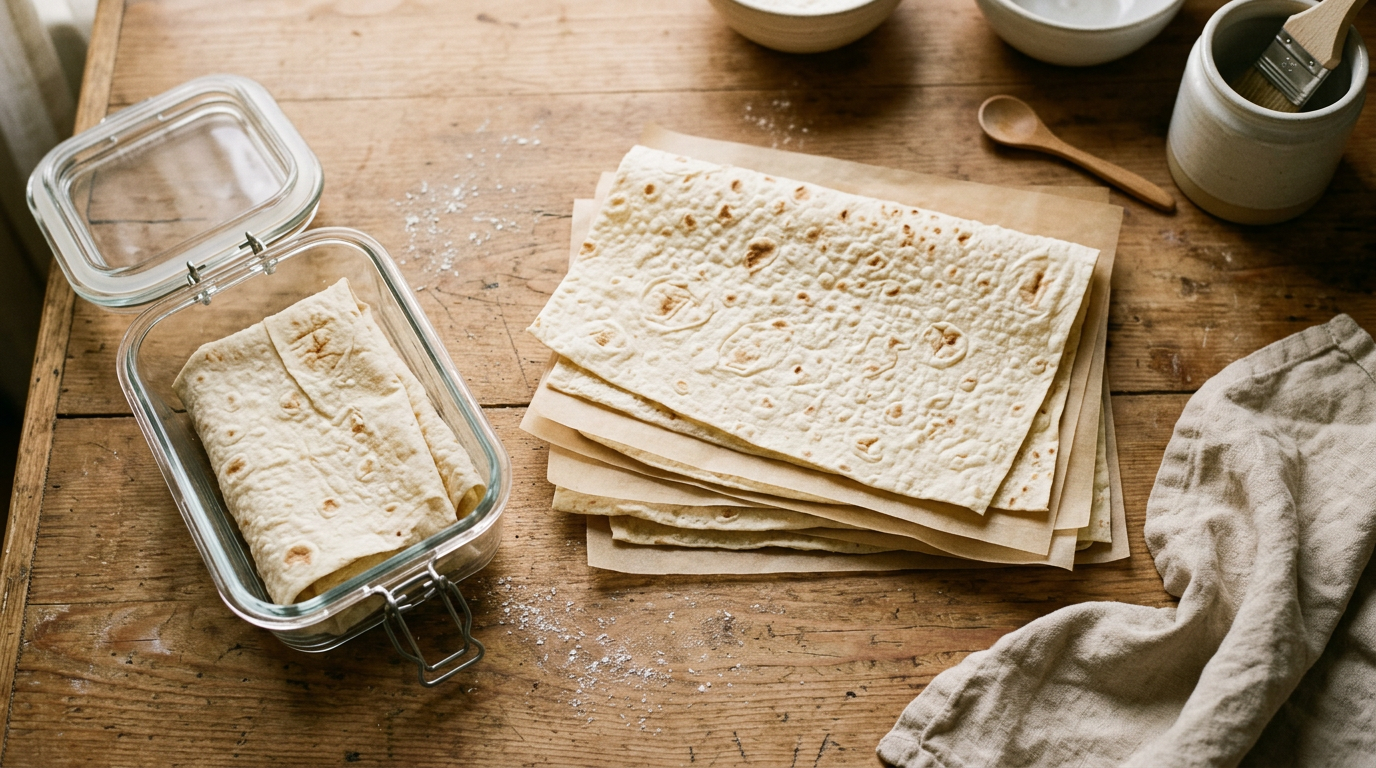
Quick Verdict: Here’s how to store lavash bread properly — 3–5 days at room temperature in a sealed bag, up to 3 weeks refrigerated, and up to 6 months frozen. The trick to keeping it soft isn’t just where you store it — it’s how you seal it and how you bring it back to life before serving
Knowing how to store lavash bread properly is the difference between a soft, pliable wrap and a dry, brittle sheet a few days later. Fresh lavash is best eaten the same day it’s baked, but that’s not always realistic — especially if you’ve ordered a multi-pack online or made a big batch for a family dinner. The good news: lavash is one of the most forgiving flatbreads to store, as long as you follow a few simple rules. Here’s exactly how to keep it soft, fresh, and ready to use for days or even months.
Here’s the quick version, method by method — full step-by-step instructions for each one are below.
| Method | Duration | Steps | Best For |
|---|---|---|---|
| Room Temperature | 3–5 days | Cool completely, layer with parchment paper, seal in an airtight bag with air pressed out, store in a cool, dry spot | Bread you’ll use within the week; best texture for wraps |
| Refrigerator | 2–3 weeks | Same layering, use a zip-top bag or airtight container with air pressed out, store in the main compartment (not the door) | Extending freshness beyond a week without much texture loss |
| Freezer | Up to 6 months | Cool completely, layer with parchment, wrap tightly in plastic, then place in a freezer-safe bag or container; label with the date | Bulk orders or stocking up for the long term |
| Reviving | As needed | Stovetop (5–10 sec/side), dry skillet (10–15 sec/side), foil-wrapped oven at 300°F (5 min), or damp-paper-towel microwave (10–15 sec) | Restoring softness to stale, refrigerated, or frozen lavash before serving |
Room Temperature: Best for 3–5 Days
If you plan to use your lavash within the week, room temperature storage is the simplest option.
- Let the bread cool completely if it was freshly baked — sealing warm bread traps steam and causes mold.
- Stack the sheets with a small piece of parchment paper between each one, so they don’t stick together.
- Place the stack in an airtight bag or container, pressing out as much air as possible.
- Store in a cool, dry spot — away from direct sunlight or your stove’s heat.
Stored this way, lavash stays soft and pliable for 3 to 5 days. After that, it will start to dry out and become brittle — still edible but better suited for chips or dipping than for wraps.
Refrigerator: Best for 2–3 Weeks
Refrigeration significantly extends lavash’s shelf life without sacrificing much texture, as long as you seal it properly.
- Cool completely, then layer with parchment paper the same way as above.
- Use a zip-top bag with the air pressed out, or an airtight container — moisture loss is the main enemy here.
- Store in the refrigerator’s main compartment, not the door (temperature fluctuates more there).
Refrigerated lavash stays fresh for 2 to 3 weeks. It will firm up slightly in the cold, but a quick reheat (see below) brings back its pliability.
Freezer: Best for Up to 6 Months
Freezing is the best option if you’ve bought in bulk or want to stock up without worrying about spoilage.
- Cool completely before freezing — never freeze warm bread.
- Layer sheets with parchment paper between each one, exactly as with fridge storage.
- Wrap the stack tightly in plastic wrap, then place it inside a freezer-safe bag or container. This double layer prevents freezer burn.
- Label the bag with the date — frozen lavash is best used within 6 months for optimal texture, though it remains safe well beyond that.
To thaw: move the stack to the refrigerator overnight, or let it sit at room temperature for about 30–60 minutes before use. Avoid microwaving straight from frozen — it can turn gummy in the center.
How to Revive Stale or Refrigerated Lavash
Cold or slightly dry lavash doesn’t mean it’s ruined — a few seconds of the right heat brings it right back:
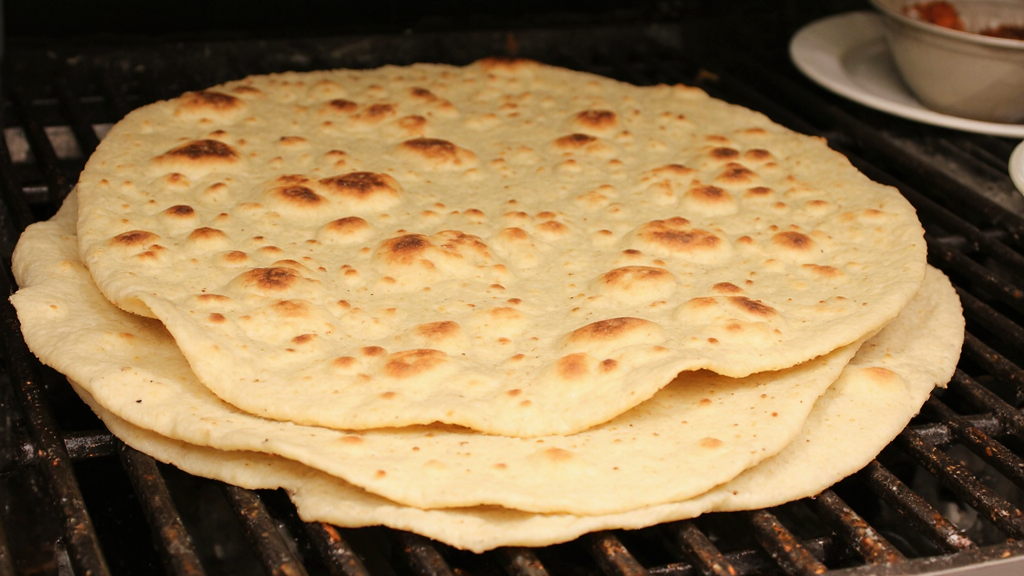
- Stovetop (best method): Hold the bread briefly over a gas burner on low, flipping once or twice, for about 5–10 seconds per side.
- Dry skillet: Warm a dry pan over medium heat and press the lavash against it for 10–15 seconds per side.
- Oven: Wrap in foil and warm at 300°F for 5 minutes.
- Microwave (last resort): Dampen a paper towel, wrap the bread in it, and microwave for 10–15 seconds only — any longer and it turns tough.
A light mist of water on the bread before reheating helps restore softness, especially for refrigerated or frozen lavash.
Storage Mistakes to Avoid
Most lavash that goes bad too early didn’t fail because of where it was stored — it failed because of one of these:
- Sealing it while still warm. Warm bread trapped in a bag creates steam, and steam speeds up mold growth even in the refrigerator or freezer.
- Using a container that isn’t fully airtight. Even a small gap lets moisture escape — and without preservatives protecting it, lavash dries out fast once air gets in.
- Storing in the refrigerator door. Temperature swings there are bigger than in the main compartment, which speeds up staling.
- Skipping the parchment paper between sheets. Stacked lavash sticks together when cold, and tears when you try to peel it apart.
- Microwaving straight from frozen. It reheats unevenly and turns gummy in the center — thaw first, then reheat using one of the methods above.
- Reusing a bag or container that held something else without airing it out first. Lingering odors and moisture transfer to the bread faster than you’d expect, especially in the refrigerator.
Signs Your Lavash Has Gone Bad
Lavash is a low-moisture bread, so it’s more prone to drying out than molding — but it’s still worth knowing the warning signs:
- Visible mold — any fuzzy spots (white, green, or black) mean it’s time to discard the whole batch, not just the affected piece.
- Off smell — a sour or musty odor is a clear sign it’s no longer safe to eat.
- Excessive hardness — dry, cracker-like lavash isn’t spoiled, just stale. It’s still safe to eat and great for dipping or turning into chips, even if it’s no longer ideal for wraps.
Why Preservative-Free Armenian Lavash Behaves Differently Than Store-Bought Bread
Most supermarket flatbread is formulated to survive weeks on a shelf at room temperature, using preservatives to slow mold growth and staling. Breadmasters’ lavash isn’t made that way — no preservatives, which is part of why it tastes closer to fresh-baked bread than something built to sit in a warehouse. It also means the shelf-stability rules printed on a supermarket flatbread bag simply don’t apply here.
Without preservatives doing the work, moisture control does the work instead. That’s the whole reason the room-temperature window above is measured in days, not weeks, and why refrigeration and freezing make such a real difference: cold slows down the physical drying and mold growth that would otherwise happen faster in a preservative-free product.
There’s an upside to this trade-off. Because nothing artificial is propping up the shelf life, a quick reheat restores lavash’s softness almost completely, the same way it would with any fresh-baked bread. Preservative-added flatbread can stay technically “fresh” well past its best texture — preservative-free lavash tells you clearly when it’s past its prime, and gives you the tools above to stretch that fresh window as long as you actually need it.
How to Store Other Breadmasters Flatbreads
The storage principles above are built around lavash specifically, but if you’ve got other Breadmasters breads in your kitchen, a few differences are worth knowing.
- Sangak and Sangak Crisps are thicker and chewier than paper-thin lavash, so they tend to hold moisture — and stay soft — a bit longer at room temperature. The same sealing and refrigeration approach above still applies.
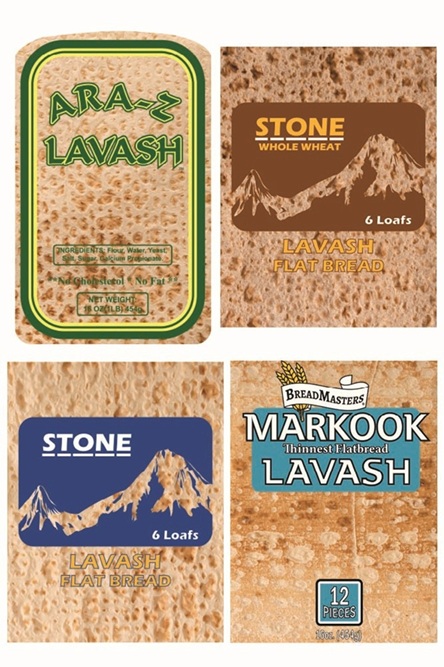
- Markook is just as thin and pliable as lavash and should be stored exactly the same way — cool, seal, and refrigerate or freeze for anything beyond a few days.
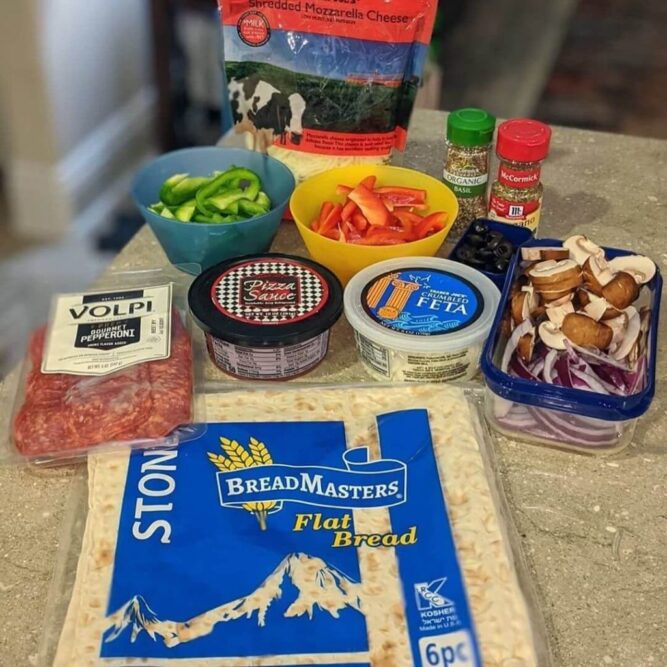
- Stone Lavash is baked a little sturdier than our standard lavash, which makes it slightly more forgiving if it sits out longer than planned, but it still benefits from the same airtight sealing and refrigeration for longer storage.
When in doubt, check the specific product’s packaging — bake dates and best-by guidance can vary slightly between products.
The Bottom Line
Preservative-free lavash rewards a little more care than supermarket bread, but not much more effort. Seal it well, refrigerate or freeze anything you won’t use within a few days, and revive it with a few seconds of heat before serving. Follow that, and a single order of Breadmasters lavash can realistically last you weeks instead of days.
Frequently Asked Questions
How long does lavash bread last at room temperature?
Properly sealed lavash stays fresh at room temperature for 3 to 5 days. After that, it dries out but remains safe to eat.
Can you freeze lavash bread?
Yes. Layered with parchment paper and sealed in a freezer-safe bag, lavash freezes well for up to 6 months without significant loss of quality.
How do you keep lavash bread soft?
Store it in an airtight bag or container with as much air removed as possible, and reheat briefly (5–10 seconds per side on a stovetop or dry skillet) before serving to restore softness.
Does lavash bread need to be refrigerated?
No, but refrigeration extends its shelf life from about 5 days to 2–3 weeks, making it a good option if you don’t plan to use it all within the week.
Can you eat stale lavash bread?
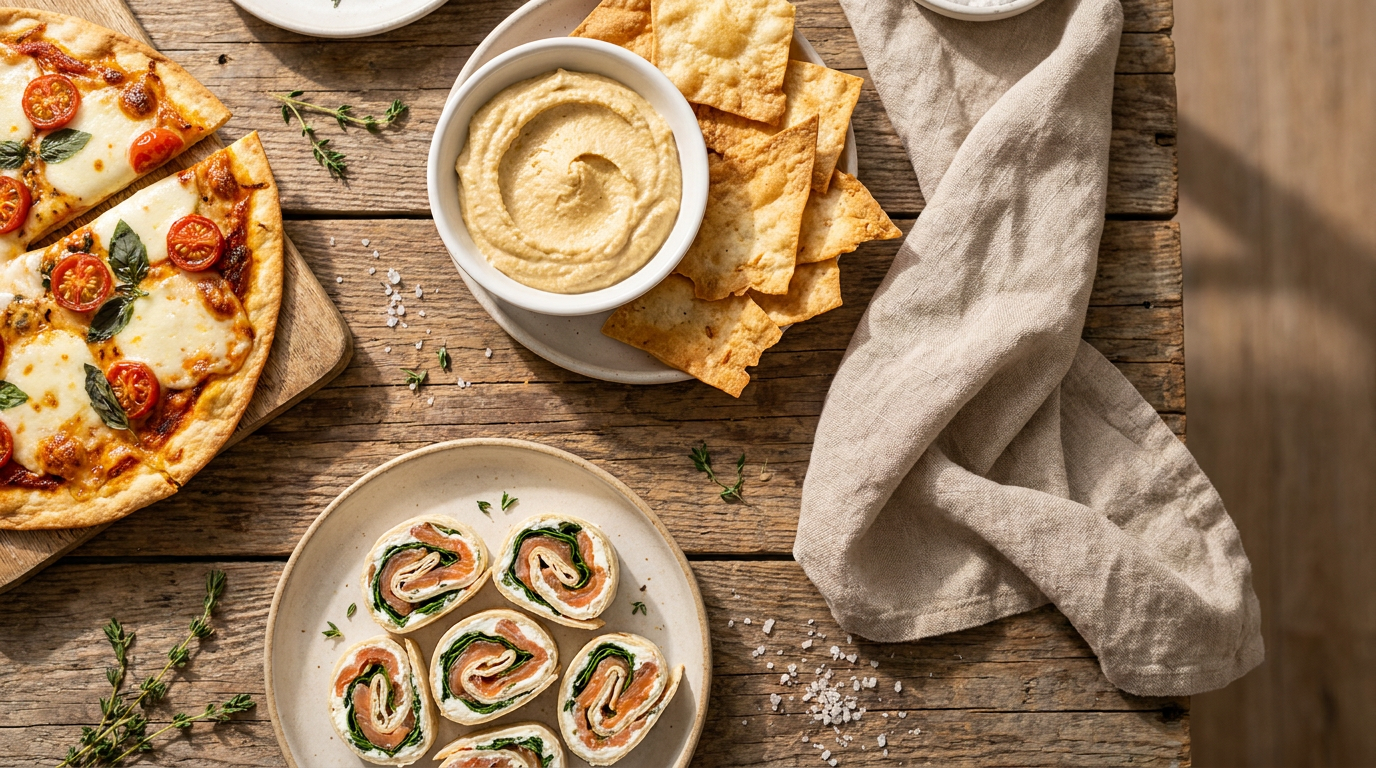
Yes — stale lavash is simply dry, not spoiled. It’s perfect for making crispy lavash chips or using as a base for dips, even past its ideal wrap-and-roll stage.
Does Breadmasters lavash contain preservatives that affect shelf life?
No — Breadmasters lavash is baked without artificial preservatives. That’s exactly why the storage steps above matter more here than they would for a preservative-added supermarket flatbread: without preservatives doing the work, sealing out air and moisture is what keeps it fresh.
Can I store Sangak the same way as lavash?
The same core principles apply — cool completely, seal tightly, and refrigerate or freeze for longer storage. Sangak is thicker and chewier than paper-thin lavash, so it tends to hold moisture and stay soft a bit longer at room temperature. Check the packaging for guidance specific to your batch.
How is Armenian lavash different to store than supermarket flatbread?
Supermarket flatbread is usually formulated with preservatives to survive weeks at room temperature. Traditional Armenian lavash like ours isn’t — it’s closer to fresh-baked bread, which means it rewards the same care you’d give any preservative-free loaf: proper sealing, refrigeration or freezing beyond a few days, and a quick reheat to bring back softness.
Looking for lavash to store? Shop our fresh-baked lavash flatbread, shipped nationwide from our Commerce, California bakery. Want to learn more about this ancient Armenian staple? Read our complete lavash guide.

![Lavash Bread vs Naan: Which is Right for Your Kitchen? [2026]](https://www.breadmasters.com/wp-content/uploads/lavash_bread_vs_naan-_which_is_right_for_your_kitchen.png)